
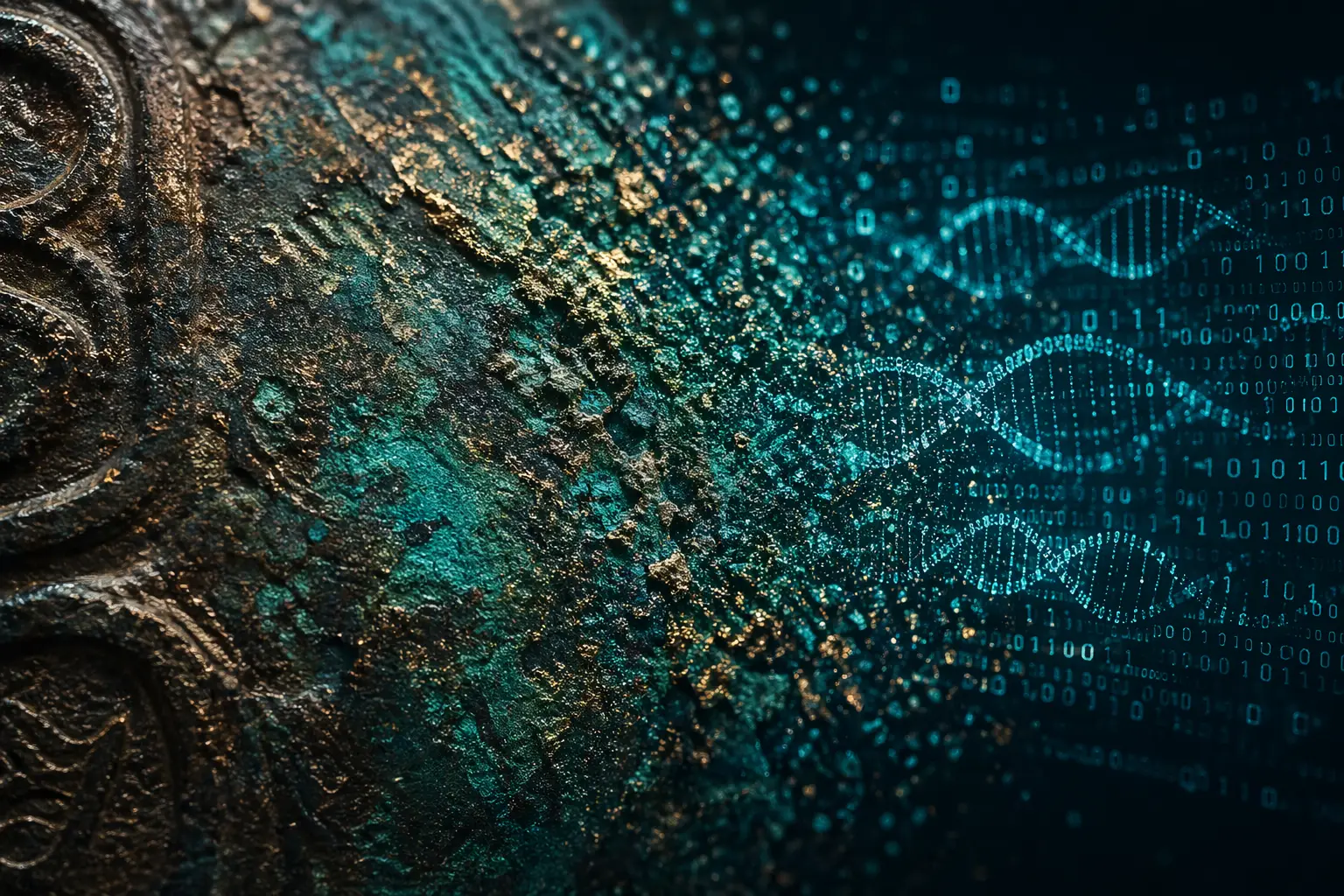
Every year, billions of euros change hands in the art and collectibles market.
Paintings travel across continents. Sculptures change ownership. Luxury objects are insured, auctioned, inherited, donated.
And in most cases, the authenticity of these objects — the very foundation of their value — still rests on a piece of paper, and the reputation of whoever signed it.
In 2026, this is still the norm.
The real problem is not forgery
When people think about authenticity in high-value markets, they think about fakes.
And fakes are indeed a serious problem — the art market alone is estimated to lose billions each year to forgery and misattribution.
But forgery is a symptom, not the disease.
The deeper issue is structural: the link between a physical object and its identity has never been made tamper-proof.
Certificates get lost or damaged.
Expert opinions diverge.
Provenance documents can be falsified — or selectively omitted.
And every time an object changes hands, the chain of trust is rebuilt from scratch, based on whoever happens to be in the room — and whatever documentation they can provide.
This is not a niche problem.
It affects art, collectibles, luxury goods, cultural heritage, archaeological artefacts — any market where value depends on what something is, not just what it looks like.
The vulnerability is always the same:
trust is layered on top of the object, not built into it.
Why technology alone hasn’t solved it
Blockchain has been proposed as the answer for years.
And it does solve part of the problem: immutable records, transparent ownership history, tamper-proof timestamps.
But blockchain can only secure what has been correctly registered in the first place.
If the link between the physical object and its on-chain identity is weak — a serial number, a photograph, a certificate — then the system is only as strong as that initial connection.
A perfect digital record of a fraudulent claim is still a fraudulent claim.
The missing piece is not digital.
It’s physical.
A different architecture
This is the problem Digital Téchne is designed to solve.
Our approach starts from the object itself.
Using genomic analysis, we extract a biological signature directly from the material — wood, canvas, stone, textile, metal.
This signature is:
- unique
- unreplicable
- permanently bound to the object
It cannot be transferred to a copy.
It cannot be forged.
It does not depend on any external authority.
That signature becomes the anchor for everything else.
It is registered on a blockchain dossier, creating an immutable and verifiable record of provenance, ownership and custody history.
A digital twin — an NFT-based tokenized representation — makes that identity accessible, transferable and liquid across platforms and markets.
The result is not a better certificate.
It is a fundamentally different model of trust.
Authenticity that is scientifically verifiable.
Provenance that is cryptographically secure.
An identity that travels with the object — not behind it, not beside it, but embedded within it.
Why this matters now
We are entering a phase where physical and digital value are converging.
Tokenization is opening new markets for fractional ownership of real-world assets.
Institutional collectors and investors are demanding higher standards of traceability.
Regulatory frameworks around cultural heritage and anti-money laundering are tightening.
In this context, the question is no longer whether high-value physical assets need a better trust infrastructure.
The question is what that infrastructure should be built on.
At Digital Téchne, our answer is clear:
It should be built on the object itself — on science, not paper.
On architecture, not reputation.
Because trust that can be removed is not really trust.
It is a layer.
And layers, by definition, can be peeled away.